
Loading...

Build a Better Data Breach Playbook

by Michael Bruemmer 4 min read November 16, 2021

Hackers are playing the game of data compromise, and they are winning. At this point, companies of all sizes, from all industries, know that consumers have a growing desire totake control of their data and digital privacy. In case you missed the latestwebinarandwhitepaperrelease from Javelin Strategy & Research, it makes three things clear about consumers’ current attitudes about fraud and its impact on businesses.

1. Consumers are much more privacy-aware

In 2020, consumers turned to social media and telecommunicating platforms to work, stay in touch with friends and family networks and learn. While the broad-scale increase provided a way for global commerce and connections to continue during the worldwide pandemic, it also accelerated cybercrime. The influx of internet traffic created a ready-made environment for fraudsters to profit from consumers in a big way, primarily through scams. Scams were so profitable that they accounted for $43 billion of the $56 billion reported ID fraud losses last year.1

2. Consumers blame Financial Institutions for fraud. It’s the main reason they leave.

When consumers experience fraud, they blame their financial institutions, even if the loss has nothing to do with the institution or its business’s responsibility to the consumer. This attitude shows that consumers hold FIs accountable for their data protection. And when they don’t get it, they take their expectations and their business elsewhere. The data shows the proof. In 2020, 38% of consumers closed a bank account affected by fraud, with 69% saying their primary FIs did not resolve their fraud concerns or losses.1As the saying goes, perception is reality, and in the case of fraud, consumer thoughts have real consequences for organizations.

3. Consumers leave when breaches happen

This point is simple: consumers leave even when personally identifiable information (PII) or other data is not stolen.

Be prepared with a playbook or be ready to lose consumer trust
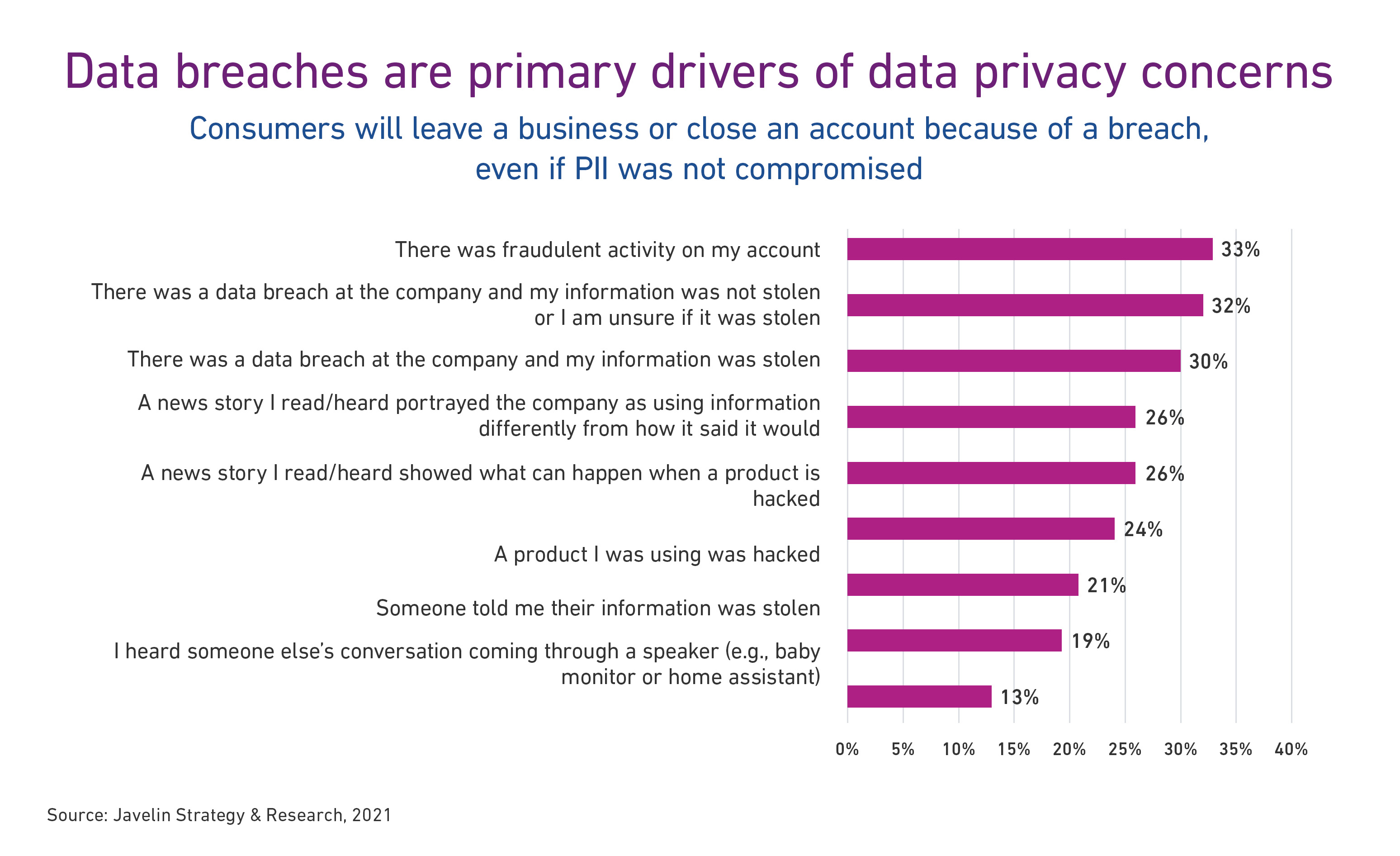
To improve the customer experience, build trust and reduce risk, companies need a playbook—a fraud resolution and breach response playbook—a solid plan that falls under their existing business and continuity disaster recovery plan. Why? Because consumers need to know and, more importantly, trust that companies are prepared to react quickly and deliver resolution when a network intrusion occurs.

According to Javelin Strategy & Research data, fraud resolution is the best way to retain customers and members. In addition, consumer perception of cybersecurity plays a significant role in consumer attrition and retention. Again, even if personal information is protected, if your organization is attacked, consumers are more likely to stop doing business with your organization, even if no data was compromised. This means cybersecurity and fraud prevention empowerment is a game-changer, driving 22% of consumers’ satisfaction ratings with online banking.2

When building your playbook, consider two core things:

1. Make sure it’s well-developed

A comprehensive fraud resolution and breach response should include a solid approach to collaborate with consumers when fraud occurs. Ensuring your plan includes fraud, cyber, and marketing communications teams will help your company act swiftly and build consumer confidence.

2. Don’t just encrypt data; strengthen perimeter security.

Strong perimeter security will ensure safe interactions with consumers. Even if personal information is protected, consumers will perceive a penetration of the network as a breach and will be more apt to stop doing business with your company.

At Experian, preparedness is our business. We know how important fraud resolution and breach response is to your customer’s experience. Developing a solid playbook is key to that experience, building trust and reducing risk.

To learn more, read theGiving Consumers Control and Enhancing Fraud Preventionwhitepaper,watch theEmpowerment and Fraud Prevention are Keywebinarand find out how to protect your business withExperian’s Global Data Breach Solutions.


1 Javelin Strategy & Research. March 2021.

2 Javelin Strategy & Research. June 2021.

Related Posts

For many banks, first-party fraud has become a silent drain on profitability. On paper, it often looks like classic credit risk: an account books, goes delinquent, and ultimately charges off. But a growing share of those early charge-offs is driven by something else entirely: customers who never intended to pay you back. That distinction matters. When first-party fraud is misclassified as credit risk, banks risk overstating credit loss, understating fraud exposure, and missing opportunities to intervene earlier.  In our recent Consumer Banker Association (CBA) partner webinar, “Fraud or Financial Distress? How to Differentiate Fraud and Credit Risk Early,” Experian shared new data and analytics to help fraud, risk and collections leaders see this problem more clearly. This post summarizes key themes from the webinar and points you to the full report and on-demand webinar for deeper insight. Why first-party fraud is a growing issue for banks  Banks are seeing rising early losses, especially in digital channels. But those losses do not always behave like traditional credit deterioration. Several trends are contributing:  More accounts opened and funded digitally  Increased use of synthetic or manipulated identities  Economic pressure on consumers and small businesses  More sophisticated misuse of legitimate credentials  When these patterns are lumped into credit risk, banks can experience:  Inflation of credit loss estimates and reserves  Underinvestment in fraud controls and analytics  Blurred visibility into what is truly driving performance   Treating first-party fraud as a distinct problem is the first step toward solving it.  First-payment default: a clearer view of intent  Traditional credit models are designed to answer, “Can this customer pay?” and “How likely are they to roll into delinquency over time?” They are not designed to answer, “Did this customer ever intend to pay?” To help banks get closer to that question, Experian uses first-payment default (FPD) as a key indicator. At a high level, FPD focuses on accounts that become seriously delinquent early in their lifecycle and do not meaningfully recover.  The principle is straightforward:  A legitimate borrower under stress is more likely to miss payments later, with periods of cure and relapse.  A first-party fraudster is more likely to default quickly and never get back on track.  By focusing on FPD patterns, banks can start to separate cases that look like genuine financial distress from those that are more consistent with deceptive intent.  The full report explains how FPD is defined, how it varies by product, and how it can be used to sharpen bank fraud and credit strategies. Beyond FPD: building a richer fraud signal  FPD alone is not enough to classify first-party fraud. In practice, leading banks are layering FPD with behavioral, application and identity indicators to build a more reliable picture. At a conceptual level, these indicators can include:  Early delinquency and straight-roll behavior  Utilization and credit mix that do not align with stated profile  Unusual income, employment, or application characteristics High-risk channels, devices, or locations at application Patterns of disputes or behaviors that suggest abuse  The power comes from how these signals interact, not from any one data point. The report and webinar walk through how these indicators can be combined into fraud analytics and how they perform across key banking products.  Why it matters across fraud, credit and collections Getting first-party fraud right is not just about fraud loss. It impacts multiple parts of the bank. Fraud strategy Well-defined quantification of first-party fraud helps fraud leaders make the case for investments in identity verification, device intelligence, and other early lifecycle controls, especially in digital account opening and digital lending. Credit risk and capital planning When fraud and credit losses are blended, credit models and reserves can be distorted. Separating first-party fraud provides risk teams a cleaner view of true credit performance and supports better capital planning.  Collections and customer treatment Customers in genuine financial distress need different treatment paths than those who never intended to pay. Better segmentation supports more appropriate outreach, hardship programs, and collections strategies, while reserving firmer actions for abuse.  Executive and board reporting Leadership teams increasingly want to understand what portion of loss is being driven by fraud versus credit. Credible data improves discussions around risk appetite and return on capital.  What leading banks are doing differently  In our work with financial institutions, several common practices have emerged among banks that are getting ahead of first-party fraud: 1. Defining first-party fraud explicitly They establish clear definitions and tracking for first-party fraud across key products instead of leaving it buried in credit loss categories.  2. Embedding FPD segmentation into analytics They use FPD-based views in their monitoring and reporting, particularly in the first 6–12 months on book, to better understand early loss behavior.  3. Unifying fraud and credit decisioning Rather than separate strategies that may conflict, they adopt a more unified decisioning framework that considers both fraud and credit risk when approving accounts, setting limits and managing exposure.  4. Leveraging identity and device data They bring in noncredit data — identity risk, device intelligence, application behavior — to complement traditional credit information and strengthen models.  5. Benchmarking performance against peers They use external benchmarks for first-party fraud loss rates and incident sizes to calibrate their risk posture and investment decisions.  The post is meant as a high-level overview. The real value for your teams will be in the detailed benchmarks, charts and examples in the full report and the discussion in the webinar.  If your teams are asking whether rising early losses are driven by fraud or financial distress, this is the moment to look deeper at first-party fraud.  Download the report: “First-party fraud: The most common culprit”  Explore detailed benchmarks for first-party fraud across banking products, see how first-payment default and other indicators are defined and applied, and review examples you can bring into your own internal discussions.  Download the report Watch the on-demand CBA webinar: “Fraud or Financial Distress? How to Differentiate Fraud and Credit Risk Early”  Hear Experian experts walk through real bank scenarios, FPD analytics and practical steps for integrating first-party fraud intelligence into your fraud, credit, and collections strategies.  Watch the webinar First-party fraud is likely already embedded in your early credit losses. With the right analytics and definitions, banks can uncover the true drivers, reduce hidden fraud exposure, and better support customers facing genuine financial hardship.

by Brittany Ennis 4 min read February 12, 2026

Discover why Experian’s unified fraud prevention platform, backed by decades of data stewardship and AI innovation, is the trusted choice for enterprises seeking scalable, compliant, and transparent identity verification solutions.

by Laura Davis 4 min read December 8, 2025

Learn how you can mitigate e-commerce fraud with identity verification and fraud prevention best practices.

by Theresa Nguyen 4 min read December 3, 2025